

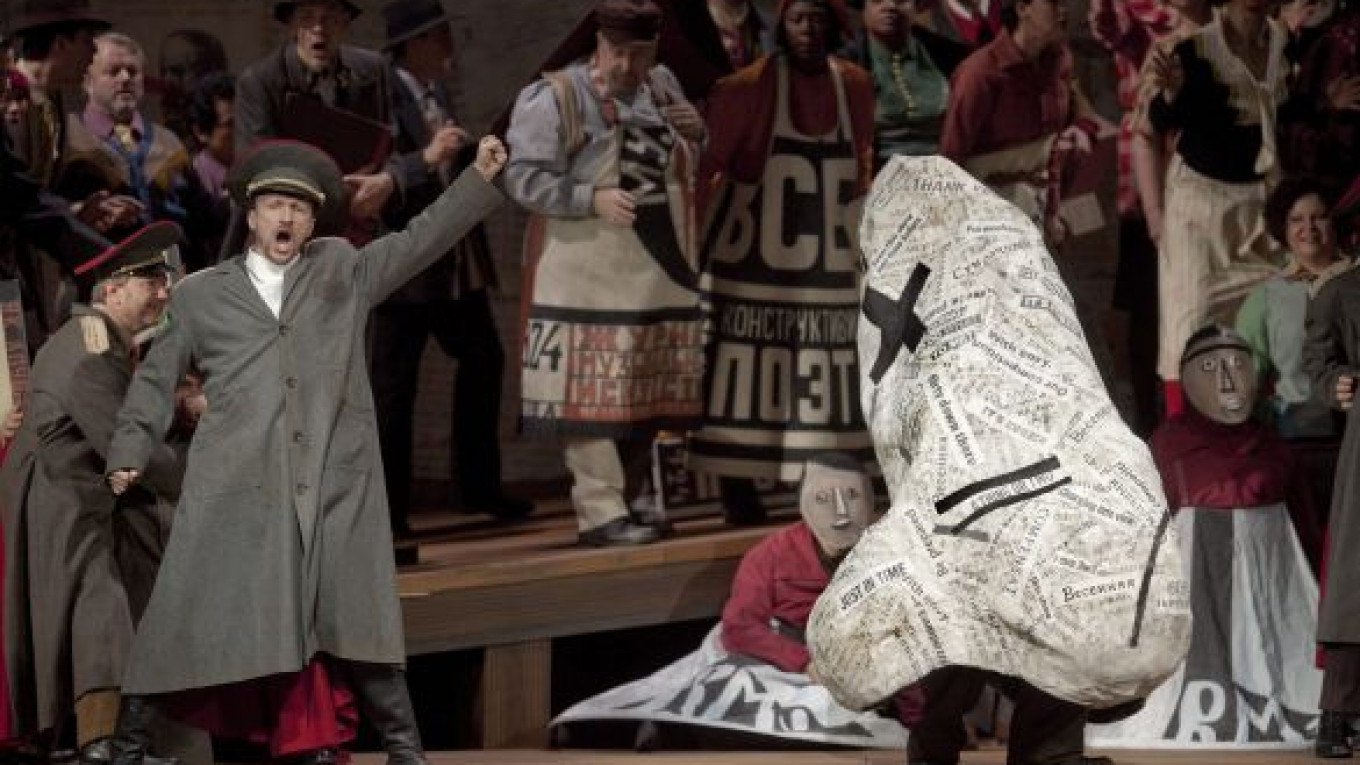
NEW YORK — A nose goes rogue, running off to experience life at its absurd best.
The amused audience at the Metropolitan Opera premiere watched the nose fall in love, take a graceful turn as a ballerina and ride proudly at the head of a military parade.
Using drawings, collage, old Soviet film footage and enigmatic, handmade projections, South African artist William Kentridge created a phantasmagorical showcase for Dmitry Shostakovich’s first opera, “The Nose.”
The 80-year-old piece was taking its first bow at the Met along with Kentridge and Paulo Szot, the Brazilian showboat who recently radiated suave charm as Emile De Beque in “South Pacific” next door at the Vivian Beaumont Theatre.
Cast as the hapless and understandably befuddled Russian functionary Kovalyov, who wakes up to find his face as smooth as a blin, or Russian-style crepe, Szot revealed a great talent for comedy and an expressive baritone capable of filling the Met’s cavern.
Based on Nikolai Gogol’s 1836 short story, the opera mocks snobby St. Petersburg society.
Like everyone else, collegiate assessor Kovalyov is highly sensitive to class distinctions, so when he spots his missing appendage at Kazan Cathedral, he is horrified that the nose now outranks him. When Kovalyov fearfully approaches, he is snubbed by his own nose looking down at him.
Shostakovich was 22 when he wrote “The Nose,” and it’s full of youthful, snarky exuberance. Brashly modern, the piece sends up the petty tyranny of Russian life, the idiocy of the press and the corruption of the police.
Stalin was not amused. “The Nose” was quickly denounced and not performed in the Soviet Union for more than four decades after its premiere at St. Peterburg’s Maly Theater.
Kentridge replaced the stage curtain with a giant collage, replete with photos, maps, text and charming animation. A dissonant tune played by brass and percussion signaled the start of the action, and a small window opened to reveal an old-fashioned barber shaving his client.
In the chair, Kovalyov sings the very first words: “Ivan Yakovlevich, your hands always stink!” And they are not all that stinks in town. It’s rather surprising that Stalin didn’t pack the composer off to a cold place.
Scaffolding and clever boxes moved on and off the stage represent the cathedral, a newspaper office and the police chief’s house.
Flitting through the scenes, the nose assumes a fabulous life of its own. It dances like Pavlova, paints huge portraits of Stalin and rescues a woman from a jeering pack of men. Even after it’s back on Kovalyov’s face, the nose retains its celebrity status, with rumors flying and crowds jostling for the chance of a brief sighting.
Yet blah-blah is not this nose’s strong suit as it struts through town, though tenor Gordon Gietz filled his two minutes with aplomb. Of the many Russians on stage, tenor Andrei Popov, from the Mariinsky Theater, was a standout in the brief role of the Police Inspector.
Valery Gergiev conducted a suitably rambunctious performance. This isn’t a melodic score, and he brought out its spike modernity with humor and energy.
A Message from The Moscow Times:
Dear readers,
We are facing unprecedented challenges. Russia's Prosecutor General's Office has designated The Moscow Times as an "undesirable" organization, criminalizing our work and putting our staff at risk of prosecution. This follows our earlier unjust labeling as a "foreign agent."
These actions are direct attempts to silence independent journalism in Russia. The authorities claim our work "discredits the decisions of the Russian leadership." We see things differently: we strive to provide accurate, unbiased reporting on Russia.
We, the journalists of The Moscow Times, refuse to be silenced. But to continue our work, we need your help.
Your support, no matter how small, makes a world of difference. If you can, please support us monthly starting from just $2. It's quick to set up, and every contribution makes a significant impact.
By supporting The Moscow Times, you're defending open, independent journalism in the face of repression. Thank you for standing with us.

Remind me later.